
Peptide Syringes: Read Units, mL and Needle Sizes
Read the mark, then check the concentration
On a U-100 syringe, 10 units means 0.1 mL. That stays the same on a 0.3, 0.5 or 1 mL barrel.
The mark tells you the liquid volume. The vial’s concentration tells you how much medicine that volume contains. A syringe mark alone is not a peptide dose.
Same mark. Same volume.
10 on U-100 0.1 mL
0.3 mL barrel Holds 30 scale units
0.5 mL barrel Holds 50 scale units
1 mL barrel Holds 100 scale units
First confirm the scale says U-100 and that the prescribed product is intended to be measured with that device. A pen has its own instructions.
Three numbers on the package, three meanings
Know which number you’re reading
Barrel · gauge · length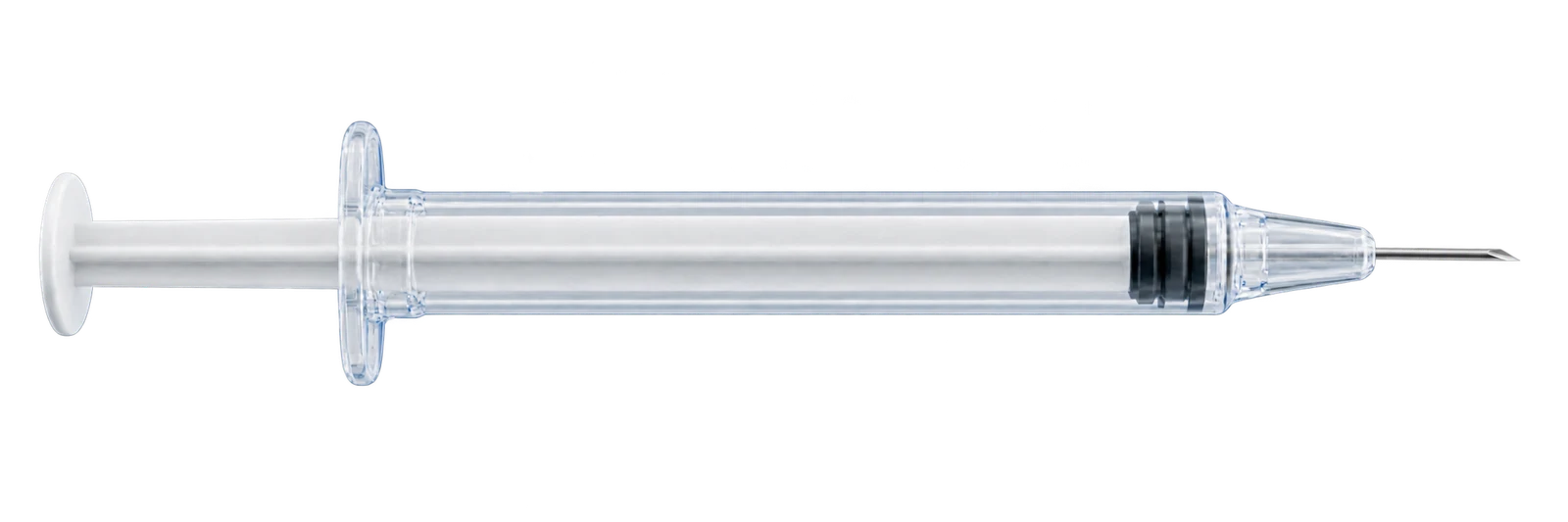
U-100 example · 0.3 mL = 30 units Each small step = 1 unit
- 1 Barrel capacity
- mL = how much it holds
Common capacities are 0.3, 0.5 and 1 mL. Capacity is a volume, not a medicine dose.
- 2 Needle thickness
- G = gauge
A higher G number means a thinner needle.
- 3 Needle length
- mm = how long it is
For example, “31G × 6 mm” gives two separate dimensions: thickness and length.
Check the scale too: U-100 means 100 scale units per mL. These markings are not mg or hCG IU.
Concept illustration, not to scale. Tick spacing varies by syringe; check your device label.Start by matching the prescribed liquid volume and route to the supplied device. A smaller barrel can make its markings easier to read, but it still must hold the required volume and have suitable increments.
How insulin syringe units work
U-100 is a scale designed for insulin containing 100 insulin units per mL. Its volume relationship stays the same across U-100 barrel capacities:
| U-100 scale reading | Liquid volume |
|---|---|
| 1 | 0.01 mL |
| 5 | 0.05 mL |
| 10 | 0.10 mL |
| 25 | 0.25 mL |
| 50 | 0.50 mL |
| 100 | 1.00 mL |
For example, the 10 mark still means 0.1 mL on both a 0.3 mL and a 1 mL U-100 barrel.
A 0.3 mL U-100 syringe holds 30 scale units. It is not a different “U-30” concentration scale. Likewise, a 0.5 mL barrel holds 50 U-100 scale units. FDA’s semaglutide dosing-error alert illustrates why confusing 5 with 50 units can cause a tenfold overdose.
Matching syringe units to your peptide dose
Keep three quantities separate: amount (mg or mcg), concentration (mg/mL), and liquid volume (mL). For a prescribed amount, divide by concentration to obtain volume. Only then translate volume into the confirmed syringe scale.
Worked example · no medicine or dose is being recommended
- Amount
- 0.2 mg
- Concentration
- 2 mg/mL
- Liquid volume
- 0.1 mL
0.2 mg ÷ 2 mg/mL = 0.1 mL
0.1 mL = the 10-unit line on a U-100 scale.
The example is arithmetic, not a recommended medicine or dose. 1 mg = 1,000 mcg; convert before dividing if the prescription and concentration use different mass units. The reconstitution guide explains the calculation and why the product’s labeled final concentration matters.
A new vial may have a different concentration. Reusing an old “number of units” instruction without checking can change the delivered amount even when the syringe is identical.
Check the smallest graduation
One small gap is not always one unit. These two examples cover the same 0–10 range, with different increments:
One small gap can mean different amounts
1-unit increments Each gap = 0.01 mL on U-100
2-unit increments Each gap = 0.02 mL on U-100
Read the device, not just the big number
-
Confirm the scale
Look for U-100, another insulin concentration, or an mL scale.
-
Confirm capacity and increments
Check how much the barrel holds and what each smallest line represents.
-
Match the written instructions
The prescribed amount, concentration, volume and marked line must agree. Ask the pharmacist to demonstrate if they do not.
Half-unit models also exist. A device comparison filed with FDA documents half-unit, one-unit and two-unit markings across specific syringe models. Capacity alone does not establish the smallest increment.
Choosing the right needle gauge
Gauge describes thickness; length describes depth. Higher gauge numbers mean thinner needles, but gauge alone does not tell you the intended tissue or make a device appropriate. Barrel capacity, readable graduations, needle length and the product instructions all matter.
Do not choose an injection angle or needle length from the peptide name. Have the dispensing team match the device and technique to the prescribed route and demonstrate it. A fixed needle versus a detachable connection also does not, by itself, establish the barrel’s measurement scale.
Harm reduction and safety
Use a new sterile needle and syringe for every injection and every entry into a vial. Do not share equipment or keep single-dose vial leftovers for another injection. Dispose of used equipment in an appropriate sharps container according to local instructions. CDC injection-safety guidance.
If an amount may have been measured incorrectly, contact the prescriber, pharmacist or local poison service promptly rather than using a half-life curve to decide it will be fine.
Frequently asked questions
Are IU and U-100 markings the same? No. IU describes a substance’s biological activity. U-100 syringe markings encode a volume for a specified insulin concentration. hCG IU, for example, cannot be read directly from a U-100 line without the product’s concentration.
Can I substitute U-40? It is a different scale. Do not transfer a U-100 marked-line instruction to it.
What if the calculation falls between lines? Do not invent precision or round a potent medicine on your own. Ask for a device or prescription instruction that can measure the intended amount accurately.
Does a small barrel mean a small dose? It means a small volume capacity. The medicine amount still depends on concentration.
Sources
- FDA dosing-error alert
- FDA-filed device comparison, Table 2: model-specific half-, one- and two-unit increments.
- CDC injection safety
Related compounds & model context
Article citations are linked in the text. Related catalog entries have separate model inputs and source notes, which may include unverified estimates. See our methodology for model assumptions and limitations.