
Peptide Reconstitution: From Vial Label to Measured Amount
From label to measured volume
Reconstitution turns a powder into liquid using the product’s specified diluent. It changes the concentration, not the total amount of medicine in the vial.
Keep three quantities separate: medicine in the vial, medicine per mL, and the volume to measure. The exact product instructions come before the arithmetic.
How the units connect
-
Powder in vial
mgTotal medicine in vial
-
Prepared liquid
mg/mLMedicine per mL
-
Measured volume
mLLiquid to measure
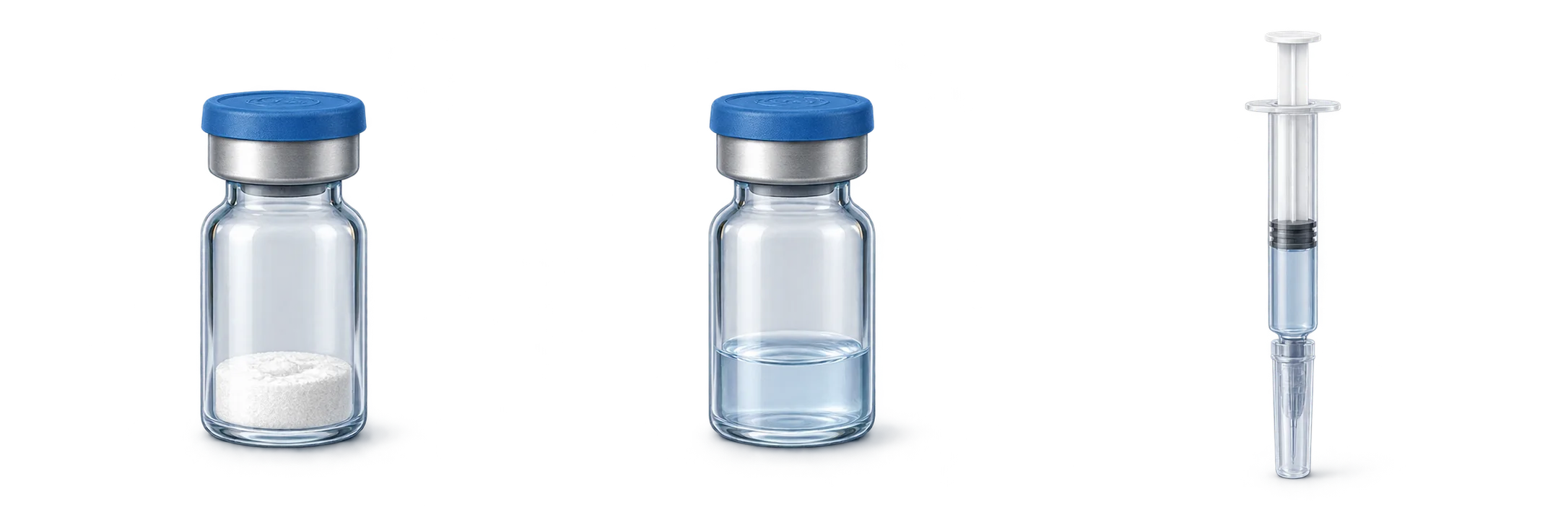
Prescribed amount ÷ concentration = volume
Follow the product’s mixing instructions and use its labeled final concentration.
Concept illustration; objects and liquid levels are not to scale.What you need before mixing
Have these four things together:
- Product: full formulation name and vial strength.
- Preparation directions: specified liquid, volume and handling instructions.
- Prescription and device: prescribed amount, route and measuring scale.
- Storage instructions: the mixed medicine’s use period and discard date.
Have the dispensing pharmacist resolve a missing or conflicting instruction before preparation. A calculator cannot identify an unknown powder or choose its compatible liquid.
1. Match the formulation, not just the compound name
A familiar ingredient is not enough. Different formulations of tesamorelin have different preparation and storage rules; EGRIFTA WR explicitly distinguishes its instructions from SV. Its patient directions also call for training before first use. FDA WR label
This is why an old screenshot, another person’s vial or a generic online peptide chart may not apply. Check the actual formulation and the current directions supplied with it.
2. Find each detail before starting
| Information to locate | What it answers |
|---|---|
| Diluent name and preparation volume | Which liquid and amount are specified? |
| Mixing method and expected appearance | What should the preparation look like? |
| Final concentration | How much drug is in each mL? |
| Prescribed amount and route | What does the prescription actually ask for? |
| Measuring device | Which markings correspond to the prescribed volume? |
| Storage and discard instructions | Use immediately, or keep under specified conditions? |
Another sterile liquid is not automatically a compatible replacement. See the diluent comparison. If preparation does not match the directions, do not improvise by adding more liquid or another ingredient.
3. Check units after the instructions are clear
Milligrams measure drug amount; milliliters measure volume. Syringe markings describe a device scale. “Ten units” without the device and concentration does not identify an amount of drug.
FDA reports substantial overdoses caused by confusion between these quantities in compounded semaglutide. FDA dosing-error alert
Worked example · no medicine or dose is being recommended
- Amount
- 0.2 mg
- Concentration
- 2 mg/mL
- Liquid volume
- 0.1 mL
0.2 mg ÷ 2 mg/mL = 0.1 mL
0.1 mL = the 10-unit line on a U-100 scale.
The arithmetic relationship is volume = prescribed amount ÷ final concentration, with matching units. For a worked hypothetical illustration, use the beginner’s unit guide. Correct arithmetic cannot validate an unverified vial strength or replace the prescribed amount.
4. Keep handling and storage instructions together
Preparation requires the product’s aseptic handling procedure and suitable sterile equipment. CDC recommendations explain why new needles and syringes and appropriate vial handling matter.
Keep both the medicine and diluent instructions available. Record a preparation or opening date when it starts the product’s in-use period. Do not apply the diluent’s discard date to the mixed medicine; see the storage guide.
Frequently asked questions
What if the specified diluent is unavailable?
Ask the dispensing pharmacist. Another sterile liquid may not be compatible, and this guide cannot assign a substitute.
Can I save whatever remains in the vial?
Only as the exact product instructions permit. Leftover volume does not establish that later use is intended.
What if the label and calculator disagree?
Resolve the mismatch with the pharmacist before use. A calculator checks arithmetic, not the prescription, product identity or final concentration.
Related compounds & model context
Article citations are linked in the text. Related catalog entries have separate model inputs and source notes, which may include unverified estimates. See our methodology for model assumptions and limitations.