
Peptide Reconstitution: Understand mg, mL and Syringe Units
Read the numbers before mixing
mg is the medicine amount. mL is the liquid volume. Concentration connects them—and explains why someone else’s syringe mark may mean a different amount.
Reconstitution means adding a specified liquid to a powder. The exact product instructions tell you which liquid and how much; this guide helps you understand the numbers.
How the units connect
-
Powder in vial
mgTotal medicine in vial
-
Prepared liquid
mg/mLMedicine per mL
-
Measured volume
mLLiquid to measure
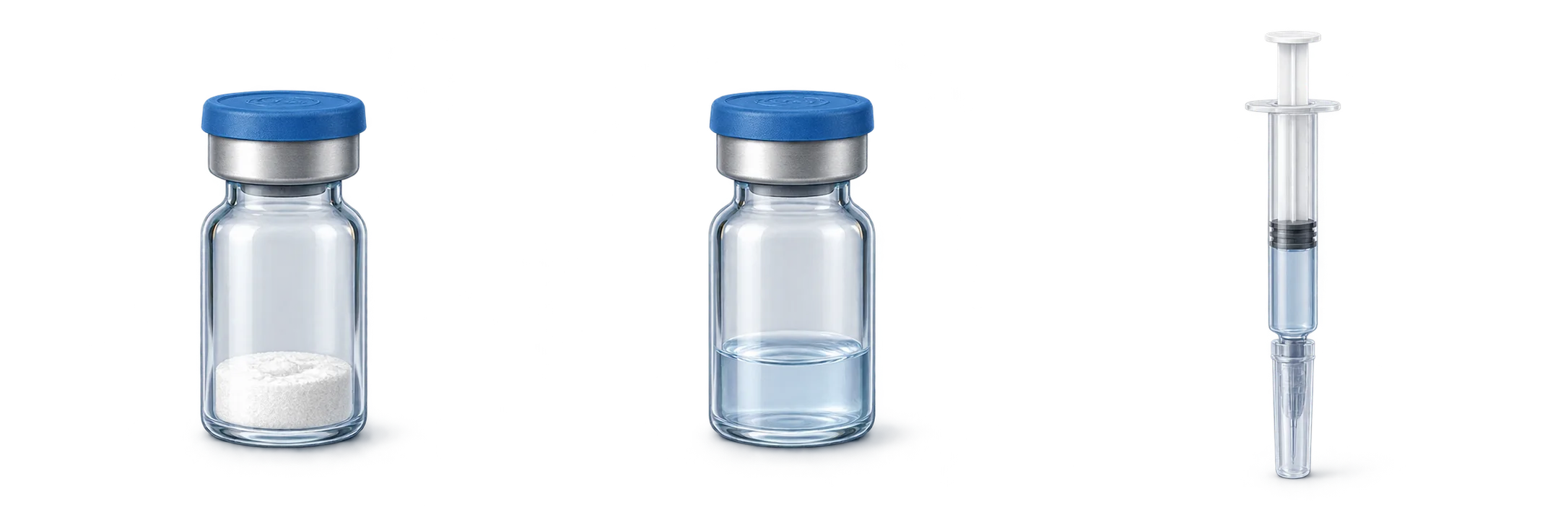
Prescribed amount ÷ concentration = volume
Follow the product’s mixing instructions and use its labeled final concentration.
Concept illustration; objects and liquid levels are not to scale.From an amount to a volume
Use the prescribed amount and the product’s stated concentration. Divide the amount in mg by the concentration in mg/mL:
Worked example · no medicine or dose is being recommended
- Amount
- 0.2 mg
- Concentration
- 2 mg/mL
- Liquid volume
- 0.1 mL
0.2 mg ÷ 2 mg/mL = 0.1 mL
0.1 mL = the 10-unit line on a U-100 scale.
This is a hypothetical calculation with two known inputs. It does not choose a dose or a mixing recipe. Use the labeled final concentration when converting a prescribed amount to volume.
Why someone else’s “10 units” can be a different dose
For the same illustrative 0.2 mg amount:
| Labeled concentration | Liquid volume | U-100 syringe reading |
|---|---|---|
| 2 mg/mL | 0.1 mL | 10 |
| 4 mg/mL | 0.05 mL | 5 |
The more concentrated liquid takes half the volume for the same amount. These are arithmetic examples, not suggested concentrations to prepare. Recheck the label with each refill instead of copying an old syringe mark.
The four units you will see
1,000 mcg
Equals 1 mg
For example, 200 mcg is 0.2 mg. These describe an amount of medicine.
100 → 1 mL
On a U-100 scale
The 10-unit line represents 0.1 mL. Check that the actual device is U-100.
IU ≠ a mark
Activity is different
An IU measures biological activity. It is not a universal mL or mg conversion.
FDA has reported compounded-semaglutide overdoses involving confusion between mg, mL and syringe units. Confirm the product concentration, device and measurement with the dispensing pharmacy. FDA alert.
Before mixing: find these four details
Start with the actual product instructions
-
Exact product and liquid
Find which formulation you have and which diluent its instructions specify.
-
Preparation and final concentration
Find the product’s mixing directions and labeled strength in mg/mL.
-
Prescribed amount and device
Match the amount ordered to the measurement on the supplied device.
-
Use, storage and discard date
Check whether the prepared product must be used immediately or has specific reuse instructions.
Even products containing the same peptide can differ. EGRIFTA WR and EGRIFTA SV both contain tesamorelin, but their preparation and storage rules differ; their labels say they are not substitutable. EGRIFTA WR label, section 2.
If the box, pharmacy label or instructions disagree, have the pharmacist resolve it before preparing the medicine. A recipe for an approved product does not establish that a research powder is suitable for injection.
Use the calculator as a math check
The reconstitution calculator takes vial mass, liquid volume and an amount. It estimates concentration from the first two inputs, then converts the amount into mL and U-100 markings. It does not have a direct labeled-concentration input.
- It can check: the arithmetic and unit conversions for those inputs.
- You still need: the correct product, prescribed amount, device and labeled final concentration. A manufactured formulation’s final concentration may differ from simply dividing vial mass by added liquid.
- It cannot establish: sterility, compatibility, storage life or a suitable dose.
Do not reverse-engineer a label into those inputs just to make a result fit. If the calculated concentration differs from the labeled final concentration, resolve the difference with the pharmacy. For simple mg/mcg or U-100/mL conversions, use the unit converter.
Common questions
How much bacteriostatic water should I add?
Use the exact product instructions. They establish whether bacteriostatic water is suitable and how much to use. Choosing an amount just to reach a convenient syringe mark can change the concentration.
Does bacteriostatic water make a vial last a month?
No universal storage period follows from the liquid alone. The prepared product has its own requirements. See peptide storage for examples. A single-dose vial should not be saved for another injection, even for the same person. “Single-dose” and “single-patient-use” are different label terms; follow the exact product’s instructions. CDC guidance.
What if the powder does not dissolve?
Follow its instructions for mixing and appearance. Contact the pharmacist if it does not look as described; adding extra liquid or another substance is not a general fix.
Can I use a calculator to find my dose?
The dose is an input. The calculator converts that amount into a volume; it cannot determine which amount is appropriate for you.
Sources and calculation notes
Checked October 11, 2026. The example is arithmetic, not a regimen or a preparation protocol.
- FDA compounded-semaglutide dosing-error alert: measurement confusion, different concentrations and U-100 volume examples.
- EGRIFTA WR prescribing information, sections 2.1–2.2: formulation-specific preparation, labeled final concentration and storage.
- CDC injection-safety guidance: single-dose vial handling.
- Example calculation: 0.2 mg ÷ 2 mg/mL = 0.1 mL; 0.1 mL × 100 scale units/mL = 10 on the U-100 scale. The visual is an illustration, not a measuring device.
Related compounds & model context
Article citations are linked in the text. Related catalog entries have separate model inputs and source notes, which may include unverified estimates. See our methodology for model assumptions and limitations.